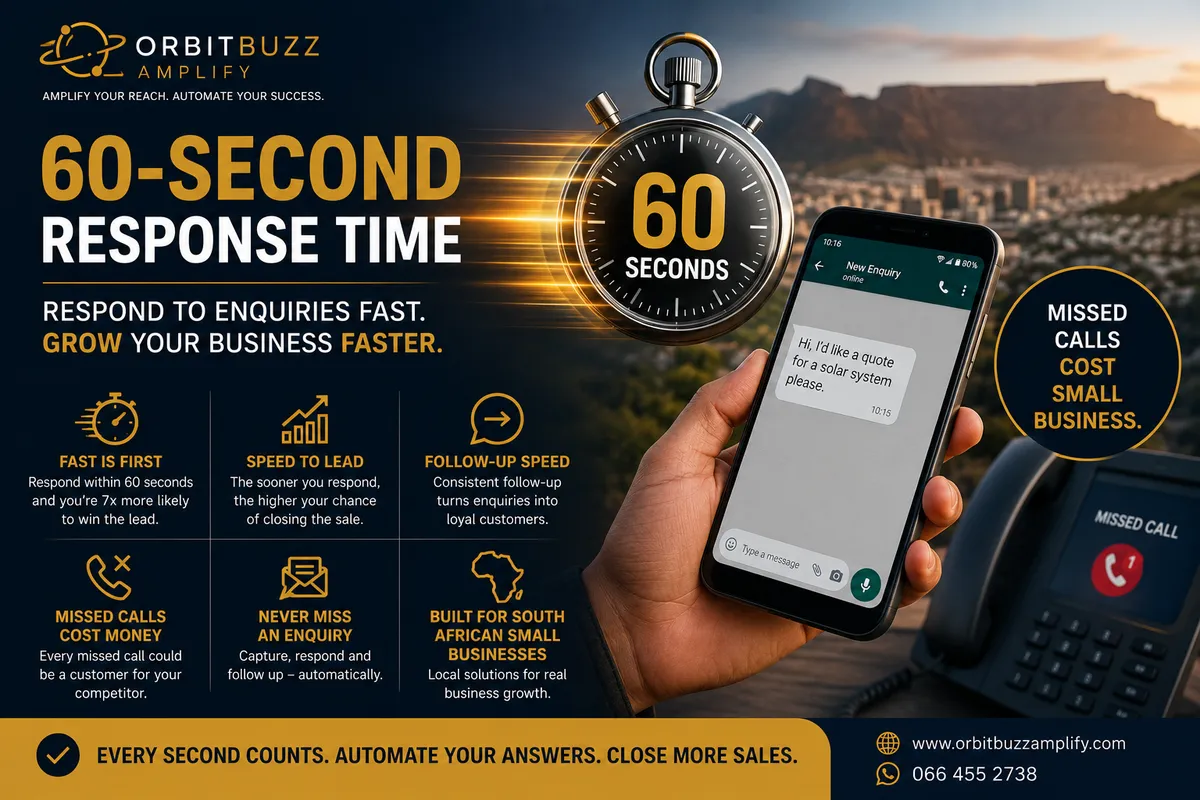
The 60-Second Window: Why Fast Replies Win Customers
The 60-second window (speed-to-lead)
1. The 60-Second Window: Why Fast Replies Win Customers in South Africa
You're doing the work. You've advertised, you've posted on Facebook, you've got the phone number on your bakkie. An enquiry comes in. You're busy with a client, or it's after hours, or you're up a ladder fixing something.
By the time you call back—maybe an hour later, maybe the next morning—they've already booked with someone else.
It's not your fault. But it is costing you.
Research shows that enquiries contacted within 5 minutes are 21 times more likely to convert than those contacted after 30 minutes. 78% of customers buy from the company that responds first—not the cheapest, not the best-reviewed. The fastest.
This article walks you through the numbers, shows you what's really happening when your phone rings unanswered, and gives you one practical way to fix it without hiring more staff.
2. The Real Cost of a Slow Reply
Let's start with what most Limpopo and Mpumalanga small businesses don't realise: small businesses miss 62% of incoming calls, costing an average of R126,000 per year in lost revenue.
That's not theory. Small businesses answer only 37.8% of inbound calls. The rest go to voicemail or ring out. And here's the part that hurts: 85% of callers who reach voicemail never call back.
They don't leave a message. They don't wait. They scroll down to the next business on Google and dial again.
You paid for that Facebook ad. You earned that referral. But if you don't answer in time, 78% of customers will buy from the first company that responds to their enquiry—even if you call back an hour later with a better price.
3. Every Minute You Wait, Your Close Rate Drops
The data is brutal and consistent across industries. After 5 minutes, enquiry quality drops by 80%. Firms that contact prospective clients within an hour are nearly seven times more likely to qualify the enquiry than those that wait 60 minutes, and companies that wait 24 hours or more are 60 times less likely to qualify the enquiry.
Why? Because the person who just Googled "plumber near me" or sent a WhatsApp asking if you're open on Saturday isn't researching. They need help now. Their geyser burst. Their salon appointment fell through. Their car won't start.
Responding within five minutes can increase conversion likelihood by several hundred percent, because people are still in research mode and actively thinking about their problem.
If you reply while they're still holding the phone, you're solving a live problem. If you reply tomorrow, you're interrupting their day to talk about something they've already handled.
4. What This Looks Like in a Real SA Small Business
Picture a small auto repair shop in Polokwane. They get 40 calls a week. They're good at what they do, but they're a two-person operation—one in the office, one in the workshop. When both are busy, calls go to voicemail.
If your average customer is worth R200 and you miss just 10 calls per month, that's R24,000 in annual lost revenue. For a service business where the average job is worth R2,000? The average missed call costs R125–R350 in immediate lost revenue, and the annual impact reaches R50,000–R200,000+ depending on call volume.
The workshop owner isn't lazy. They're busy. But busy doing the work doesn't pay the bills if new customers never get through.
5. It's a Reaction-Time Problem, Not a You Problem
Here's what matters: this isn't about you being disorganised or bad at follow-up. The average response time across businesses is 47 hours. Over 63% of businesses don't respond at all.
You're competing in an environment where most businesses are slow. The ones who win aren't necessarily better—they're just there when the customer calls.
Speed of response communicates professionalism; a customer interprets quick response as a sign of efficiency, organisation and commitment. When you reply in 60 seconds, the customer doesn't think, "Wow, they must have automation." They think, "These people are on it. I'll book with them."
6. The After-Hours Gap
44% of enquiries are generated outside of business hours. Someone's geyser bursts at 8pm. A bride-to-be scrolls Instagram at 10pm looking for a makeup artist. A farmer needs a part delivered and sends a message at 6am.
After-hours calls represent concentrated exposure; HVAC systems fail at night, pipes burst on weekends, legal crises emerge without warning.
If your phone goes to voicemail after 5pm, you've just turned away nearly half your potential customers before you even know they existed.
7. Your Next Step
You can't be awake 24/7. You can't stop doing the work to answer every call. But you can set up a system that replies instantly while you stay focused.
That's what the 60-Second Response Scorecard is for. It's a short quiz that shows you exactly where enquiries are slipping through, how much it's costing you in rand terms, and what one change would recover the most revenue.
Take the scorecard here: https://orbitbuzzamplify.com/opt-in
It takes 60 seconds (we timed it), and you'll get your score plus a breakdown of where the leaks are. No fluff, no 47-hour wait for a reply. Just the numbers you need to fix this.