Why SA Businesses Lose Customers on WhatsApp (& How to Fix It)
Why South African Businesses Lose Customers on WhatsApp—And How Done-For-You AI Fixes It
You answer every WhatsApp message. Eventually. But "eventually" is costing you customers.
South Africa has the highest WhatsApp engagement globally—96% of internet users are on the platform, and around 80% of messages are read within 5 minutes. Your prospective clients expect the same speed from your business. When they don't get it, they move on to the competitor who replies first.
In this article, you'll learn exactly why slow WhatsApp responses lose you revenue, what customers actually expect in 2026, and how done-for-you AI automation can reply to every enquiry instantly—even at 2 AM during load shedding—without you lifting a finger.
The Real Cost of a Slow WhatsApp Reply
Here's what most Limpopo and Mpumalanga business owners don't realise: the person who messages you on WhatsApp at 7 PM isn't just messaging you. They're messaging three other businesses at the same time.
78% of customers end up buying from the first business that responds. Not the best business. Not the cheapest. The first.
Small businesses miss 62% of incoming calls, costing an average of R2.3 million per year in lost revenue (converted from the USD $126,000 study figure). WhatsApp follows the same pattern. 85% of callers who reach voicemail never call back—and the same holds true for unanswered WhatsApp messages.
Let's make it concrete. You run a plumbing business in Polokwane. A homeowner messages you on Saturday afternoon: "Hi, my geyser is leaking. Can you come out today?" You're at your daughter's soccer match. You see the message three hours later and reply. By then, they've already booked the plumber who answered in five minutes. That's R1,200 gone—not because you're bad at your job, but because you weren't available when the customer needed you.
The system failed you. Not the other way around.
What Customers Actually Expect on WhatsApp in 2026
Customer expectations have shifted. Fast.
Around 60% of customers now define "immediate" as 10 minutes or less. For messaging apps like WhatsApp, expectations are even tighter than email—customers expect near-instant replies because the channel itself implies speed.
Speed of response is now ranked as the single most important factor in a support interaction by 63% of customers. Not friendliness. Not expertise. Speed.
And here's the part that hits South African small businesses hardest: customers no longer differentiate between large enterprises and small businesses when it comes to response time expectations—they expect the same speed and availability regardless of your team size.
You're competing against businesses that have receptionists, call centres, and after-hours staff. But your customers don't care that you're a one-person operation. They just know that someone else answered faster.
Why You Can't Manually Keep Up (And Shouldn't Have To)
You already know this, but let's say it plainly: you cannot be on your phone 24/7. You have jobs to do, families to see, and a life outside your business.
The old "solution"—checking your phone every 20 minutes, replying between jobs, setting alarms to follow up—isn't a system. It's exhausting yourself to plug a hole that will never stay plugged.
Here's what actually happens:
- A message comes in at 6:30 AM. You're still asleep.
- Another at 11 AM. You're on site with no signal.
- Three more between 7 PM and 9 PM. You're having dinner with your family and trying not to look at your phone every five minutes.
By the time you reply the next morning, two of those five enquiries have already moved on. You'll never know which ones would have converted, because they're already someone else's customers.
And during load shedding? Forget it. Your router is down, your laptop is off, but your customers' phones still work on cellular data. During a 4-hour Stage 4 block, customers are still awake, still active, and still sending WhatsApp messages—the business that replies wins, and the business that's dark loses.
The problem isn't you. It's that you're trying to do a 24-hour job with 8 hours of availability.
How Done-For-You WhatsApp AI Actually Works
This is where automation changes everything—but not the kind you're thinking of.
We're not talking about those clunky "away message" auto-replies that say "Thanks for your message, we'll get back to you during business hours." Those lose customers just as fast as silence does.
We're talking about a done-for-you AI system that:
- Reads the incoming WhatsApp message in real time
- Understands what the customer is actually asking (pricing, availability, booking, directions—whatever it is)
- Replies instantly with a helpful, human-sounding answer pulled from your business information
- Captures the enquiry into your CRM so you can follow up on the real opportunities
- Hands off to you only when the conversation needs a human (quotes, complex questions, or a customer who's ready to book)
WhatsApp chatbots saved over 2.5 billion hours in 2023 by resolving repetitive queries without technical expertise. For South African small businesses, that time savings translates directly into recovered revenue—because the system is doing the remembering and the replying while you're doing the actual work.
And it works during load shedding. Cloud-based AI systems keep running even when your premises lose power—your WhatsApp chatbot keeps responding to customers 24/7, no generators or UPS required.
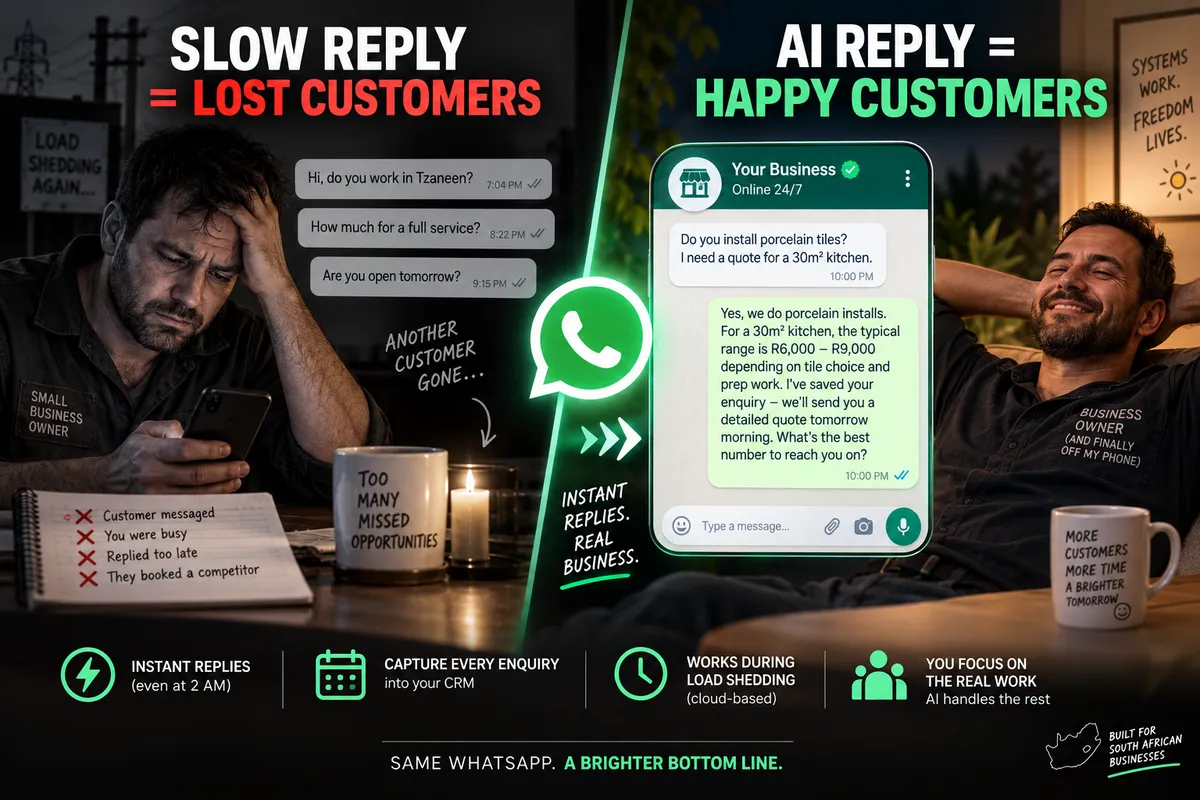
Here's an example: a Cape Town tiling business uses our WhatsApp automation through the VanX System (the platform OrbitBuzz runs on). A customer messages at 10 PM on a Sunday: "Do you install porcelain tiles? I need a quote for a 30m² kitchen." The AI replies in 18 seconds: "Yes, we do porcelain installs. For a 30m² kitchen, the typical range is R6,000–R9,000 depending on tile choice and prep work. I've saved your enquiry—Jaco will send you a detailed quote tomorrow morning. What's the best number to reach you on?"
The customer feels heard. The business captures the opportunity. And Jaco sleeps through the night. That's how it should work.
What This Actually Looks Like in Your Business
Let's walk through a typical day—before and after automation.
Before (manual WhatsApp):
7:04 AM – Message arrives: "Are you open today?" You're still asleep.
9:47 AM – You see it and reply. Customer has already called someone else.
11:23 AM – "How much for a full service on a Hilux?" comes in. You're under a vehicle with no phone access.
2:16 PM – You reply. No response. (They've moved on.)
8:39 PM – "Do you work in Tzaneen?" You're having dinner. You'll reply later.
Next morning – You reply. They booked someone last night.
Three lost opportunities. R4,500 in potential work gone.
After (WhatsApp AI automation):
7:04 AM – "Are you open today?" AI replies in 11 seconds: "Yes! We're open 8 AM–5 PM Mon–Fri, 8 AM–1 PM Sat. Need to book something in?"
Customer books an appointment through the chat. It syncs to your calendar.
11:23 AM – "How much for a full service on a Hilux?" AI replies instantly with your standard pricing, captures the vehicle details, and logs the enquiry.
You follow up at lunch with a proper quote. Customer says yes.
8:39 PM – "Do you work in Tzaneen?" AI confirms your service area and asks what they need. Customer describes the job. It's logged and waiting for you in the morning with all the context already captured.
Same day. Three conversations handled. Three opportunities saved. And you didn't touch your phone once during dinner.
That's the shift. The AI does the first reply and the qualification. You do the close and the actual work.
Why "Just Hiring Someone" Doesn't Solve This
You might be thinking: "Why not just hire a receptionist or a part-time admin to handle WhatsApp?"
Fair question. Here's the math:
A part-time receptionist in Limpopo costs roughly R4,500–R6,000/month. They work 9 AM–1 PM, Monday to Friday. That's 20 hours a week. They're off on weekends, public holidays, sick days, and after hours.
Done-for-you WhatsApp automation costs R1,900/month (our Starter Pack rate). It works 168 hours a week. It never calls in sick. It works during load shedding. It replies in under 20 seconds, every time. And it doesn't need tea breaks.
More importantly: AI-powered systems can resolve around 90% of after-hours enquiries automatically, meaning you're not paying someone to sit and wait for messages during slow periods—the system only "works" when a message actually comes in.
The AI isn't here to replace people. It's here to handle the repetitive stuff (hours, pricing, availability, bookings) so you can focus on the conversations that actually need you—the complex quotes, the upset customer, the big opportunity that needs a human touch.
Your Next Step
If you're losing enquiries to slow follow-up—or you're just tired of being glued to your phone 24/7—you don't need to fix this alone.
Take the 60-Second Response Scorecard and find out exactly how much revenue is leaking from your current follow-up system. It's a 7-question quiz that gives you a Response Score out of 100, a rand-loss estimate, and a clear picture of where your follow-up is breaking down.
https://orbitbuzzamplify.com/opt-in
Once you know your score, you'll get a 5-email series that walks you through exactly how to fix it—including how done-for-you automation plugs the gap without you becoming a tech expert.
The businesses that win in 2026 aren't the ones working hardest. They're the ones with systems that reply instantly, capture every opportunity, and let the owner get back to doing the actual work.
Your competitors are already automating. The question is: how much longer can you afford to stay manual?