Warehousing & Distribution With AI
The Silent Revolution Inside Your Warehouse: How AI Is Transforming Warehousing and Distribution Operations
The warehouse has always been the heartbeat of any distribution business — the place where speed, accuracy, and efficiency either make or break a company's reputation. For decades, improving that heartbeat meant hiring more staff, adding more shifts, or expanding physical space. In 2026, that equation has fundamentally changed. Artificial intelligence is now doing what no amount of extra headcount ever could: learning from data, predicting problems before they happen, and making thousands of micro-decisions every hour that collectively transform how goods are stored, picked, packed, and delivered. For warehousing and distribution companies that are still running on spreadsheets, gut feel, and manual processes, the gap between them and AI-powered competitors is growing wider every single month.
Smarter Inventory Management: Knowing What You Need Before You Run Out
One of the most costly problems in any warehouse is inventory imbalance — too much of the wrong product tying up capital, and not enough of the right product when customers need it. AI solves this through demand forecasting that goes far beyond simple historical averages. By analyzing purchasing patterns, seasonal trends, supplier lead times, and even external signals like weather or regional economic activity, AI-powered inventory systems can predict exactly what stock will be needed, when, and in what quantities. McKinsey research confirms that embedding AI in distribution operations can reduce inventory levels by 20 to 30 percent while simultaneously improving fill rates — meaning businesses carry less stock but fill more orders successfully. A building products distributor that implemented an AI-enabled supply chain control tower improved its fill rates by 5 to 8 percent almost immediately. For any distribution business where cash flow is tight and storage space is expensive, that kind of precision isn't a luxury — it's a survival advantage.
Picking, Packing, and Movement: The Rise of Intelligent Automation
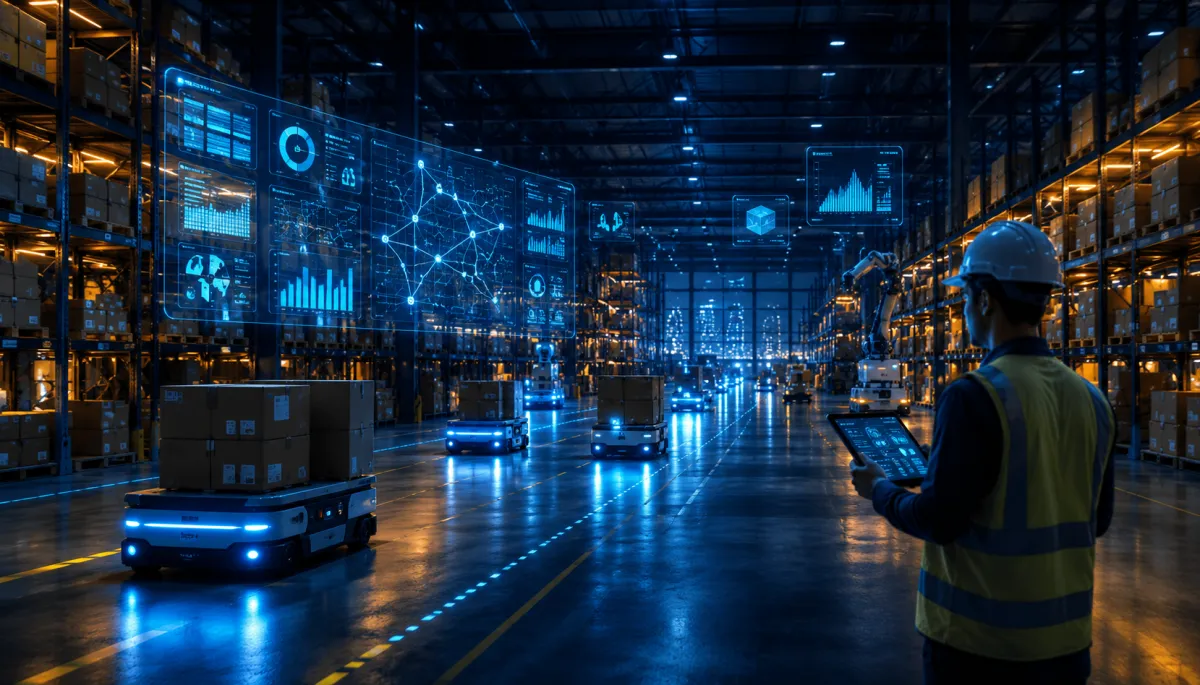
Inside the warehouse itself, the physical movement of goods has historically been one of the most labor-intensive, error-prone, and time-consuming parts of the operation. AI is reshaping this entirely. Autonomous mobile robots now form a core layer of warehouse infrastructure, with companies like Locus Robotics deploying collaborative robots that work alongside human staff to increase picking efficiency and dramatically reduce travel time inside large facilities. These systems use computer vision and real-time mapping to navigate aisles, locate products, and hand them off to human packers — cutting the time workers spend walking between shelves by as much as 60 percent. In 2026, AI-enabled vision inspection systems can identify products and barcodes in real time, while robotic de-palletizing systems handle mixed pallets, various packaging types, and irregular stacking configurations that previously required skilled human judgment. The result is faster throughput, fewer picking errors, and a significantly safer working environment — particularly for the physically demanding tasks that cause the most workplace injuries.
Route Optimization and Last-Mile Delivery: Getting It There Faster and Cheaper
Getting the right product to the right customer at the right time is only half the challenge — doing it profitably is the other. Distribution companies live and die on the efficiency of their delivery routes, and this is where AI's ability to process vast amounts of real-time data creates an immediate, measurable advantage. AI-powered route optimization systems factor in live traffic conditions, vehicle load capacities, delivery time windows, fuel costs, driver availability, and customer priority simultaneously — something no human dispatcher could ever calculate manually across dozens of vehicles and hundreds of stops. Leading distributors using AI across their transportation operations are achieving logistics cost reductions of 5 to 20 percent — a significant margin improvement in an industry where fuel and labour together represent the largest cost lines on the P&L. Beyond static route planning, AI systems adjust delivery routes in real time as conditions change during the day, rerouting drivers around accidents, delays, or last-minute order changes without any human intervention required.
Predictive Maintenance and Real-Time Visibility: Keeping the Operation Running
A warehouse that stops moving — because a conveyor belt fails, a forklift breaks down, or a cold storage unit malfunctions — loses money every minute it's offline. Traditionally, maintenance in warehousing has been reactive: equipment breaks, someone calls a technician, operations pause. AI flips this model entirely through predictive maintenance. By continuously monitoring the performance data from every piece of equipment — motors, belts, refrigeration units, vehicles — AI systems detect the early warning signs of mechanical stress or component wear long before a failure actually occurs, allowing maintenance to be scheduled during planned downtime rather than as an emergency. A major logistics provider used an AI-powered digital twin — a virtual simulation of its entire warehouse network — to increase warehouse capacity by nearly 10 percent without adding a single square metre of new real estate, running simulations to find hidden optimization opportunities specific to each facility. Real-time dashboards powered by machine learning now give warehouse managers a live view of order processing times, storage utilization, shipment accuracy, and workforce activity — enabling data-driven decisions that were simply impossible when reporting ran on yesterday's numbers. For distribution businesses managing multiple sites or complex supply chains, this level of visibility is transformative.
The Bottom Line: AI Is No Longer Optional for Distribution Businesses
MIT supply chain researchers describe AI as "not optional anymore" in large-scale warehousing and omnichannel operations — it has become foundational to how competitive facilities function at scale. By 2026, more than 4 million warehouse robots are operational worldwide, and over 90 percent of warehouses are expected to use or plan to adopt AI-powered Warehouse Management Systems. The businesses that have already made this shift are not just running more efficiently — they are setting a new standard of speed, accuracy, and cost-effectiveness that is rapidly becoming the baseline customer expectation. For warehousing and distribution companies that haven't yet explored what AI can do for their operations, the question is no longer whether to adopt it, but how quickly they can close the gap. The good news is that AI-powered systems no longer require enterprise-level budgets or dedicated IT departments to implement — the right automation partner can help any distribution business identify where the biggest gains are hiding and build a practical roadmap to get there, one system at a time.
Sources
McKinsey & Company — Harnessing the Power of AI in Distribution Operations
https://www.mckinsey.com/industries/industrials/our-insights/distribution-blog/harnessing-the-power-of-ai-in-distribution-operationsMIT Supply Chain Frontiers Podcast (March 2026) — The State of AI in Warehousing and Omnichannel
https://ctl.mit.edu/podcasts/state-ai-warehousing-and-omnichannelTechnology.org (April 2026) — How AI Is Transforming Warehouse Operations in 2026
https://www.technology.org/2026/04/29/how-ai-is-transforming-warehouse-operations-in-2026/Omniful.ai (February 2026) — Must-Know Warehouse Statistics and Trends in 2026
https://www.omniful.ai/blog/top-warehouse-statistics-industry-trends-2026Hy-Tek Intralogistics (2025/2026) — 2026 Warehouse Automation Trends: Where Software, AI, and Robotics Converge
https://hy-tek.com/resources/2026-warehouse-automation-trends-where-software-ai-and-robotics-converge/World Business Outlook (April 2026) — Using AI and Analytics in Warehousing Operations
https://worldbusinessoutlook.com/using-ai-and-analytics-in-warehousing-operations/Distribution Strategy Group / PHCP Pros (May 2026) — Applied AI for Distributors 2026
https://www.phcppros.com/articles/23330-applied-ai-for-distributors-2026