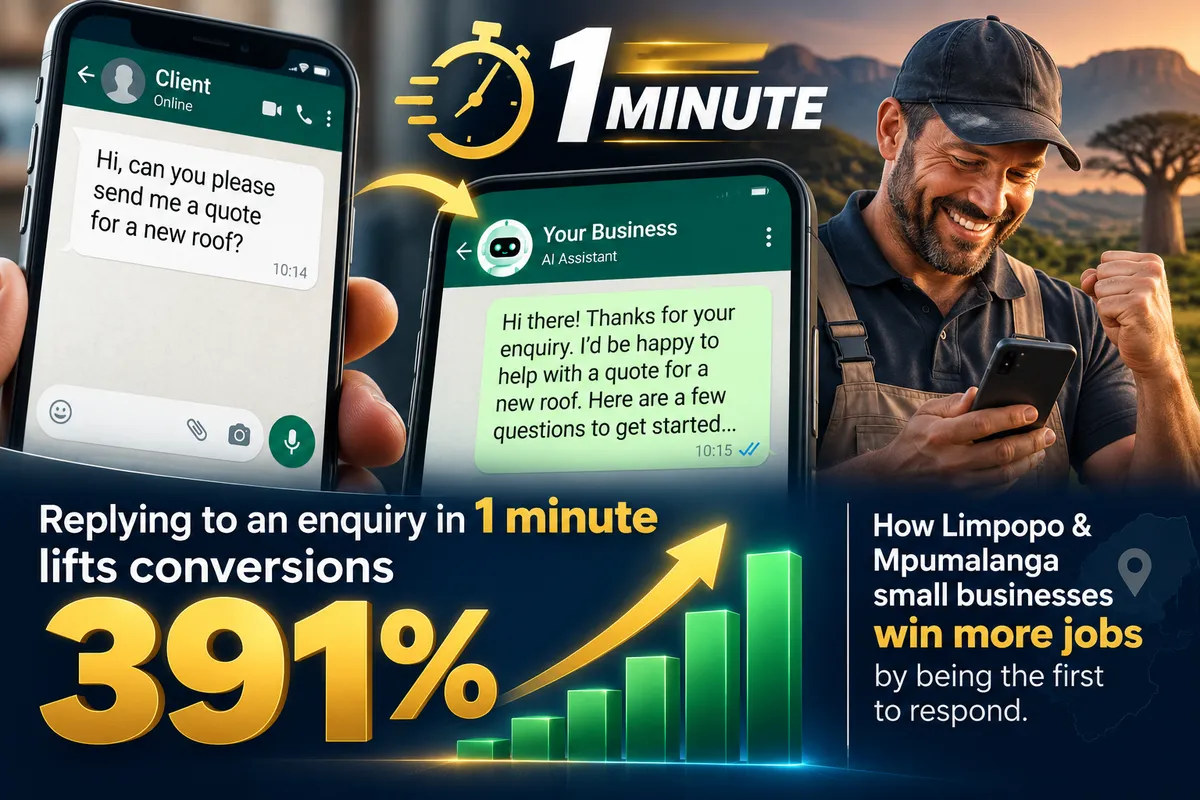
Speed-to-Lead: Why Replying First Wins the Job
The 60-Second Window — Why Speed-to-Lead Beats Everything Else
1.The 60-Second Window: Why Speed-to-Lead Beats Everything Else
You know the feeling. An enquiry comes in—a missed call, a Facebook message, a contact form on your website. You're with a client, on site, or dealing with an urgent job. You tell yourself you'll call back in an hour. Maybe two.
By the time you do, they've already hired someone else.
This isn't about working harder or being more disciplined. It's about the maths: responding to an enquiry within one minute increases conversion rates by 391% compared to responding after 30 minutes. Not 39%. Three hundred and ninety-one percent. That single minute—not your pricing, not your reputation—is often the difference between winning the job and losing it.
In this article, you'll learn what speed-to-lead really means, why the first 60 seconds matter more than the next 60 hours, and how local Limpopo and Mpumalanga small businesses can actually compete without hiring a receptionist or gluing their phone to their hand.
2.What Speed-to-Lead Actually Means (And Why It's Not About Working Faster)
Speed-to-lead is the time between when a prospective client reaches out and when your business responds. Not when you close the sale—when you first make contact.
In 2026, responding within 5 minutes is the gold standard, and under 1 minute is ideal. The research is consistent across industries: prospective clients contacted at 5 minutes are 21 times more likely to qualify than those contacted at 30 minutes. After an hour, your odds collapse even further. Responding within 1 hour makes you 60 times more likely to qualify an enquiry than waiting 24 hours.
Here's the part that matters for small businesses in towns like Groblersdal, Polokwane, or Nelspruit: 78% of customers buy from the company that responds first, and 82% of consumers expect an immediate response to sales enquiries. They're not comparing your quote to three others. They're hiring whoever picks up the phone.
3. The Local Reality: Most Small Businesses Are Losing by Default
The average company takes 47 hours to respond to an enquiry. Forty-seven hours. Nearly two full days. And 58% of companies never respond to a web enquiry at all.
You're probably doing better than that—but "better than terrible" still isn't fast enough. If you're calling back two hours later, or even 30 minutes later, the job is often gone. The caller has moved on. 62% of calls to small businesses go unanswered, and 85% of those callers never call back. They don't leave a voicemail. They don't wait. They ring the next business on Google.
Let's put a number on it. Say you run a small plumbing or electrical business in Limpopo. You get 40 enquiries a month. If you're missing or delaying even half of those calls, and your average job is worth R2,500, you're potentially leaving R50,000 on the table every single month—not because you're bad at your trade, but because your system can't keep up when you're busy.
This is the hidden cost of "I'll call them back later." It's not a follow-up problem. It's a speed problem.
4. Why the First 60 Seconds Are Worth More Than the Next 60 Hours
When someone calls or messages your business, they're in decision mode right now. They've Googled "emergency plumber Polokwane" or "electrician near me Tzaneen," they've looked at a few options, and they're ready to book. The job is urgent, or at least feels urgent.
Enquiries are most engaged right after they submit a form, send an enquiry, or request a demo—they are looking for immediate answers. That intent doesn't last. After 5 minutes, enquiry quality drops by 80%. Think about that. Four out of five potential clients who were ready to say yes five minutes ago are no longer interested half an hour later.
After 30 minutes, the enquiry is effectively cold—you are now competing against every other option they have explored in that half hour. They've called two more businesses. One of them answered. You've lost.
The first responder doesn't just get an advantage. 78% of customers buy from whichever company responds first. First doesn't mean cheapest, or best-reviewed, or most experienced. It means fastest.
This is especially true in service businesses where the need is immediate—a burst geyser, a power outage, a broken gate motor. The person who answers the call in the first 60 seconds doesn't need to be the best in town. They just need to be there.
5.What Happens When You Can't Answer: The Missed-Call Reality
Let's be honest: you can't always answer the phone. You're on a ladder, under a sink, driving between jobs, or dealing with a client who's standing right in front of you. That's normal. The problem is what happens next.
85% of missed callers never call back—they call a competitor instead. Even if you call them back 20 minutes later, they've often already booked someone else. 85% of callers who reach voicemail don't leave a message or call back, and the enquiry is effectively gone within 3 to 5 minutes of a missed call.
But here's the good news: sub-1-minute automated text-back converts at 48%, while a 30-to-60-minute callback converts at only 11%. A simple "Thanks for calling! I'm with a client—can I call you back in 15 minutes?" sent automatically within seconds keeps that prospective client warm. When the message is sent within 60 seconds, SMS response rates hit 35 to 50%, and missed-call text-back recovers 35 to 50% of those enquiries.
That's a system doing the remembering for you, not a receptionist you can't afford and definitely not a sticky note that falls off your dashboard.
6. What This Looks Like for Limpopo and Mpumalanga Small Businesses
You don't need to hire a full-time receptionist or stop doing your actual work to fix this. You need a system that responds instantly when you can't.
Here's what that looks like in practice:
- A call comes in while you're on site. An automated text goes out within 30 seconds: "Hi! I'm with a client right now. Can I call you back at 2pm, or is this urgent?" The caller replies. You've kept the conversation alive.
- A Facebook message comes in at 8pm. An instant reply acknowledges it, captures their details, and books a call for the next morning. By the time you wake up, the enquiry is already in your calendar.
- A website form is filled out on Saturday afternoon. The prospective client gets an SMS immediately with your next available slot and a link to book. They book. You show up Monday and do the job.
None of this requires you to be faster. It requires a follow-up system that works when you're busy, after hours, or simply unavailable. That's what automation does—it turns your missed calls and delayed responses into conversations that actually convert.
7. Your System Is the Problem (Not You)
If you're a small business owner in Limpopo or Mpumalanga reading this and thinking, "I already knew I should call back faster," you're right. But knowing doesn't fix it. The issue isn't discipline or effort. It's that you're trying to do a system's job with willpower and a to-do list.
Prospective clients contacted at 5 minutes are 21 times more likely to qualify than those contacted at 30 minutes. You can't be 21 times more motivated. You need a system that does the first response for you, automatically, so you can follow up when you're actually free—and still win the job.
The businesses that are winning more work in 2026 aren't working longer hours. They've just stopped losing enquiries to the businesses that reply first.
8. Your Next Step
Want to see how many prospective clients you're losing to slow follow-up right now? Use the Revenue Leak Calculator to estimate how much revenue is slipping through the cracks every month because of delayed responses.
https://orbitbuzzamplify.com/revenue-calculator-page
It takes two minutes, and it'll show you exactly what fixing your speed-to-lead is worth. Then, if you want help actually fixing it, we'll show you how.
How fast does your business typically respond to a new enquiry—minutes, hours, or the next day?