How to Measure Your Marketing ROI | OrbitBuzz Amplify
How to Calculate the ROI of Your Marketing Efforts (And Why Most Businesses Get It Wrong)
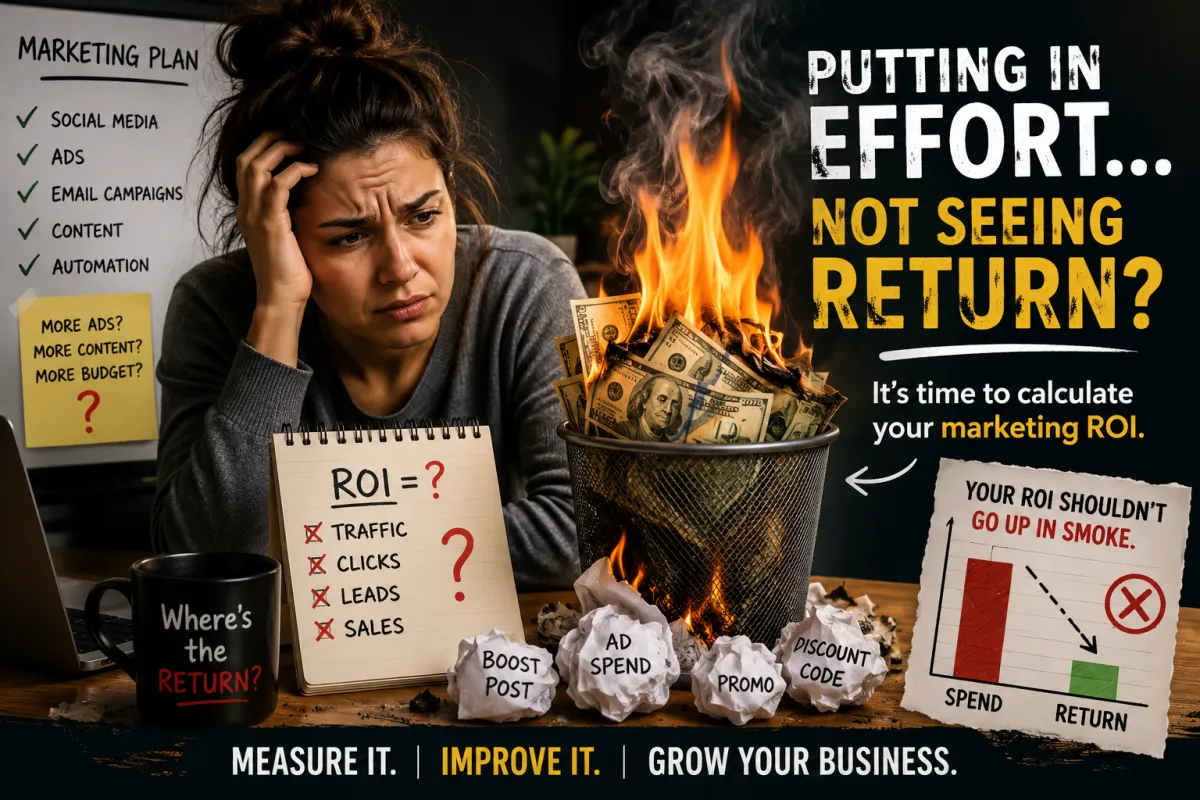
Is Your Marketing Making Money Or Are You Burning Your Budget?
Many business owners spend money on marketing every month, yet very few know whether their marketing is actually profitable.
They post on social media, run advertisements, send emails, and invest in various marketing tools i.e. Meta Adds, Google Adds etc. The problem is that without measuring Return on Investment (ROI), it's impossible to know which activities are helping the business grow and which are simply draining the budget. As a business owner, you obviously need to know your ROI and you need to understand what marketing is paying off and what marketing is simply a waste of time.
Understanding your marketing ROI is one of the most important skills a business owner can develop. It allows you to make better decisions, invest more confidently, and focus on strategies that generate real results.
What Is Marketing ROI?
Marketing ROI (Return on Investment) measures how much revenue your marketing activities generate compared to what you spent.
In simple terms:
Did your marketing make more money than it cost?
If the answer is yes, you're moving in the right direction.
If the answer is no, it's time to identify where improvements can be made.
The Marketing ROI Formula
The basic formula is:
ROI = ((Revenue Generated - Marketing Cost) ÷ Marketing Cost) × 100
This gives you a percentage that shows how effectively your marketing budget is performing.
Example:
Let's say:
You spend R5,000 on marketing.
Your marketing generates R20,000 in sales.
Calculation:
(R20,000 - R5,000) ÷ R5,000 × 100
= 300% ROI
This means that for every R1 spent on marketing, you earned R4 back.
That's a healthy return.
What Costs Should Be Included?
Many businesses underestimate their true marketing costs.
When calculating ROI, include the following costs:
Advertising Costs
Facebook Ads (Meta Adds)
Instagram Ads (Meta Adds)
Google Ads
LinkedIn Ads
Any other platforms you might be using i.e. TikTok etc. That includes "Boosting" of posts.
Software Costs
CRM systems
Email marketing platforms
Automation tools
Funnel software
Cost of your domain etc.
Content Creation Costs
Graphic design
Video editing
Photography
Copywriting
Time Costs
Your time has value too. What will be your hourly rate if people will get a service from you? Link that up to the time you take to create your marketing posts.
If you spend 20 hours per month on marketing, that time should be considered part of the investment.
The Hidden Metric Most Businesses Ignore
Revenue is important, but it's not the whole picture.
You should also track:
Cost Per Lead (CPL)
How much does it cost to generate a new lead?
Example:
Marketing spend: R2,000
Leads generated: 50
Cost Per Lead:
R2,000 ÷ 50 = R40 per lead
Cost Per Customer (CPA)
How much does it cost to acquire a paying customer?
Example:
Marketing spend: R2,000
New customers: 5
Customer Acquisition Cost:
R2,000 ÷ 5 = R400 per customer
These numbers provide valuable insight into the efficiency of your marketing systems.
Why Businesses Often Struggle to Measure ROI
Many businesses face the same challenges:
No Lead Tracking
They don't know where enquiries came from. If there are also any customers who came in via different platforms, they lose track of them because they don't work from a centralized platform.
Was it Facebook?
Maybe someone replied on Google?
Word of mouth?
Without tracking, everything becomes guesswork. That is not the ideal situation for you as a business owner. Tracking your leads, knowing exactly which platform they used and what they asked/enquired about is key in building a trust relationship.
No Follow-Up System
Leads come in but are never properly followed up.
A lead that doesn't receive a response cannot become a customer. In these calculations only leads that resulted into paying customers can be used. Not a potential customer, a customer who already paid for either your product/services.
No Centralized CRM
Customer information is spread across WhatsApp, email, social media, notebooks, and spreadsheets.
When data is scattered, accurate reporting becomes difficult. Your customers are with you in this journey once they buy from you. For them to trust you, you need to know them as a business/entity. You need to know what their problems are and how your business can help them solve it. A CRM makes that easy since it stores your conversations with your customers and looking up that history is way easier than trying to collect data from several different platforms.
No Automation
Manual processes often result in missed opportunities.
Automated systems help ensure that every lead receives timely communication and consistent follow-up. Many businesses and entities are afraid of Ai. Yet, Ai can help you immensely in your workflow processes if used in the right way. It can save you lots of time and can even be used to make sure the more serious customers are getting priority attention.
The OrbitBuzz Amplify Approach
At OrbitBuzz Amplify, we believe marketing should be measurable.
Rather than focusing only on likes, comments, and views, businesses should focus on metrics that directly impact growth:
Leads generated
Conversion rates
Customer acquisition costs
Revenue generated
Return on Investment
By combining marketing systems, automation, funnels, and CRM technology, businesses gain greater visibility into what is working and where improvements can be made.
When you can track the entire customer journey, you can make better decisions and achieve more consistent results.
Questions Every Business Owner Should Ask
At the end of each month, ask yourself:
How much did I spend on marketing?
How many leads did I generate?
How many customers did I acquire?
How much revenue did those customers generate?
What was my ROI?
If you cannot confidently answer these five questions, your marketing may be operating without clear direction.
Final Thoughts
Marketing should never be viewed as an expense.
When measured correctly, marketing becomes an investment.
The businesses that grow consistently are not always the ones spending the most money. They're often the ones tracking the right numbers, improving their systems, and making data-driven decisions.
If you want to improve your marketing performance, start by measuring it.
Because what gets measured gets improved.
And what gets improved generates growth.
For more information on OrbitBuzz Amplify follow https://orbitbuzzamplify.com