How AI is Shaping Medicine & Sport | OrbitBuzz Amplify
From the Operating Room to the Sidelines: How AI Is Quietly Rewiring the World's Core Industries
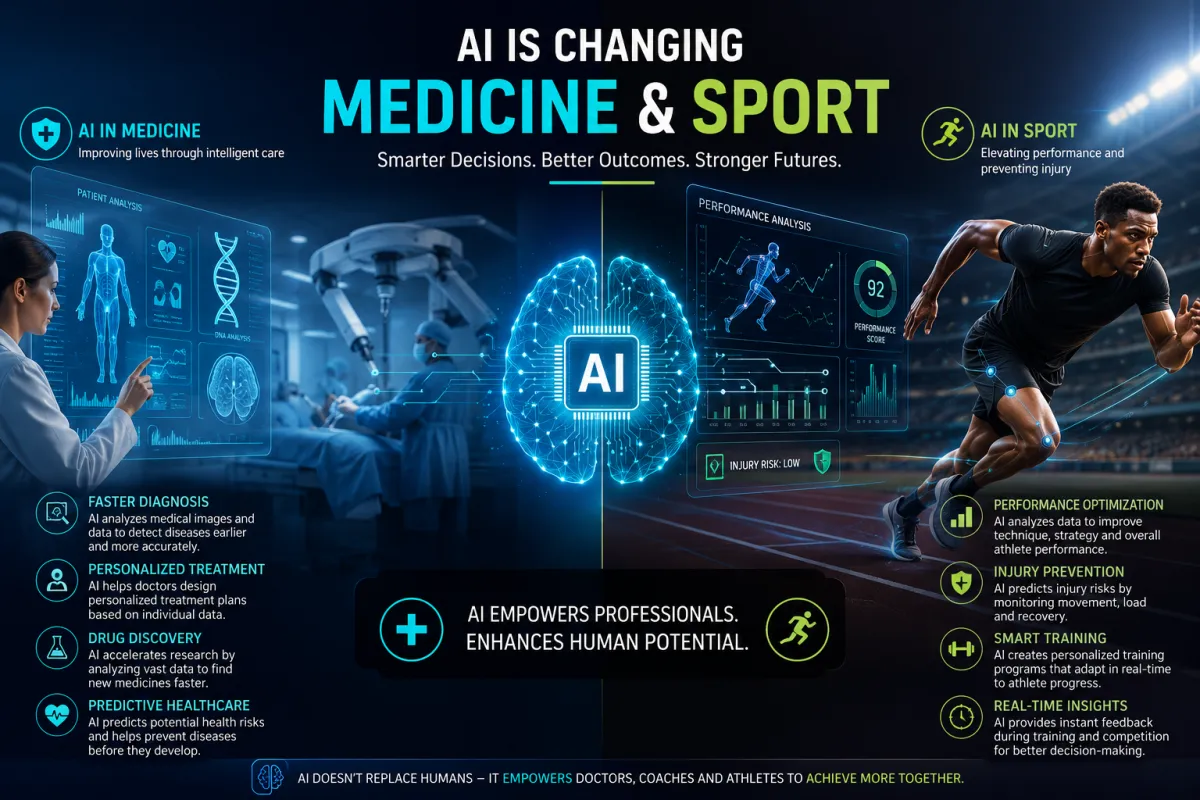
For years, "AI in healthcare" or "AI in sport" sounded like a headline from a tech keynote — exciting, but distant. That's no longer true. In 2026, artificial intelligence has moved past the demo stage and into operating theatres, training grounds, and clinical trial pipelines, producing results that are measurable, not speculative. Two industries show this shift most clearly: medicine, where AI is now designing drugs that have entered human trials, and professional sport, where it's preventing injuries before they happen. Together, they offer a preview of what AI-driven transformation looks like once it leaves the lab and starts changing how core industries actually operate.
The Most Profound Shift in Medicine: AI Is Now Designing the Drugs Themselves
For decades, drug discovery has been one of the slowest, most expensive processes in science — typically over a decade and well over a billion dollars to bring a single new medicine to market. The single most significant AI development reshaping medicine right now is the move from AI as a diagnostic assistant to AI as a drug designer, and the clearest proof of that shift is Isomorphic Labs.
Isomorphic Labs, a drug discovery company spun out of Google DeepMind, has built its entire approach around AlphaFold — the AI system that solved a fifty-year-old grand challenge in biology by predicting the 3D shape of proteins from their genetic sequence alone. What started as a scientific breakthrough in structural biology has become the foundation of a new kind of pharmaceutical company. Using an evolved version of the system, AlphaFold 3, Isomorphic Labs has been able to model not just proteins but DNA, RNA, and the small drug-like molecules that interact with them — giving researchers an unprecedented, AI-generated view into how a potential medicine will behave inside the body before it's ever synthesized in a lab.
The milestone that matters here isn't theoretical. Oncology and immunology therapies designed using this AI pipeline have now advanced into first-in-human clinical trials — a genuine first for AI-originated drug candidates, and a sign that AI-designed medicine has moved from research papers into real patients. Isomorphic Labs isn't alone either: Insilico Medicine took an AI-discovered fibrosis treatment from concept to human trials in under eighteen months, compared to roughly four years using traditional methods, and Relay Therapeutics' AI-designed cancer drug Zovegalisib has earned FDA Breakthrough Therapy Designation and is now in Phase 3 trials for metastatic breast cancer.
As of early 2026, there are more than 200 AI-discovered drugs somewhere in clinical development worldwide — most still early, none yet approved, but the pipeline itself tells the story. Industry analysts estimate a real chance the first fully AI-discovered drug receives regulatory approval within the next two years. That would mark the moment AI-designed medicine stops being a promising experiment and becomes a normal part of how new treatments reach patients.
This matters beyond the headlines because of what it implies about cost and speed. If AI can reliably shrink a multi-year discovery phase down to months, and do it for diseases that have resisted traditional drug design for decades, the entire economics of medicine begins to shift — toward more treatments, for rarer conditions, reaching patients faster than the industry's traditional pace ever allowed.
Beyond Drug Discovery: AI Quietly Running the Rest of Healthcare
While AI-designed drugs make the boldest headlines, a quieter transformation is already standard practice in hospitals. Ambient AI scribes — tools that listen to doctor-patient conversations and automatically generate clinical notes — are now used widely enough that a multi-site study across several major U.S. academic medical centers measured the effect directly: clinicians using these tools cut their total time in electronic health records by over thirteen minutes per patient encounter, and documentation time specifically dropped by sixteen minutes. For physicians who've spent years describing burnout as a documentation problem as much as a medical one, that's a meaningful and immediate quality-of-life shift, not a future promise.
Healthcare leaders are also converging on a more measured view of where AI goes next. Rather than single flashy algorithms, the expectation now is agentic systems — AI that can coordinate across imaging, lab results, and patient history simultaneously, with clinicians remaining firmly in the loop rather than being replaced by the technology. It's a more grounded vision than the AI hype of a few years ago, and arguably a healthier one: AI as a structured collaborator embedded into clinical workflow, not a replacement for medical judgment.
The Sports Industry's Version of the Same Story: Predicting Injuries Before They Happen
If medicine's AI story is about designing what doesn't yet exist, professional sport's AI story is about predicting what hasn't happened yet — and the results are now well-documented across multiple leagues.
The core innovation is predictive injury prevention: AI systems that combine GPS movement data, wearable sensor readings, biomechanical analysis, and an athlete's individual training history to flag rising injury risk before an injury actually occurs. The financial stakes alone explain why elite clubs have invested so heavily — a single serious injury to a key player can cost a club tens of millions in lost performance, medical costs, and transfer value.
The real-world results are striking. Liverpool FC adopted an AI-driven monitoring approach after a punishing injury crisis, and saw a 30% reduction in days lost to injury the very next season. Los Angeles FC, MLS champions, achieved a 53% drop in overall injuries after implementing similar analytics — including a 69% reduction specifically in non-contact injuries, exactly the category AI is best suited to anticipate. A professional rugby team using an AI training-load platform reported 30% fewer injuries and 10% greater player availability across two seasons.
What makes this approach distinct from older sports science is the sheer density of data now feeding it. Athletes are tracked through continuous biometric wearables, computer vision systems capturing movement at high frame rates, force plate measurements, and sleep monitoring — a volume of information that would have buried a human analytics team a few years ago. AI's real value isn't collecting that data; it's translating it into a single, individualized daily recommendation that a coach or medical staffer can actually act on.
It's also pushing into territory regulators are starting to take seriously. Because these systems influence decisions about an athlete's training load and competition availability, both the EU AI Act and several emerging U.S. state laws are beginning to classify sports injury-prediction tools as high-risk AI applications — alongside healthcare risk-assessment systems. That's a meaningful signal: when regulators start treating sport analytics with the same caution as clinical health tools, it confirms how directly these systems now affect real outcomes for real people.
The Common Thread Across Every Industry AI Is Reshaping
Look closely at both stories and a pattern emerges that goes well beyond medicine and sport. In each case, AI's biggest impact isn't a single dramatic breakthrough — it's the shift from reactive decision-making to predictive, individualized decision-making, built on data volumes no human team could process manually.
In medicine, that means designing a drug candidate based on a predicted molecular interaction, rather than years of trial-and-error lab testing. In sport, it means flagging an athlete's elevated injury risk three days before a tendon strain happens, rather than treating the injury after the fact. The underlying capability is the same: AI finding the early, faint signal inside an overwhelming amount of data, and turning it into a specific, actionable recommendation for a human expert to act on.
That same pattern is already extending into other core industries. Financial institutions use comparable predictive modeling to flag fraud before a transaction clears. Manufacturers use it to predict equipment failure before a production line stops. Agricultural operations use it to forecast crop stress before a harvest is lost. The specific data and stakes change industry to industry, but the underlying shift is consistent: AI is moving every sector it touches from responding to problems toward anticipating them.
What This Means Going Forward
None of this suggests AI is replacing the experts at the center of these industries — and in both medicine and sport, the systems gaining real traction are explicitly designed to keep a human decision-maker in the loop. Drug candidates designed by AI still require human-led trials, ethical oversight, and regulatory approval. Injury-risk scores still require a coach and medical staff to decide what to do with that information. The technology is proving most valuable not when it operates alone, but when it hands a qualified expert a sharper, earlier signal than they could have found on their own.
That's likely the most useful way to think about AI's trajectory across every core industry it's touching: not a replacement for expertise, but a dramatic expansion of what expertise can see coming. The organizations and professionals who learn to work alongside that expanded vision — in medicine, in sport, and well beyond — are the ones already pulling ahead.