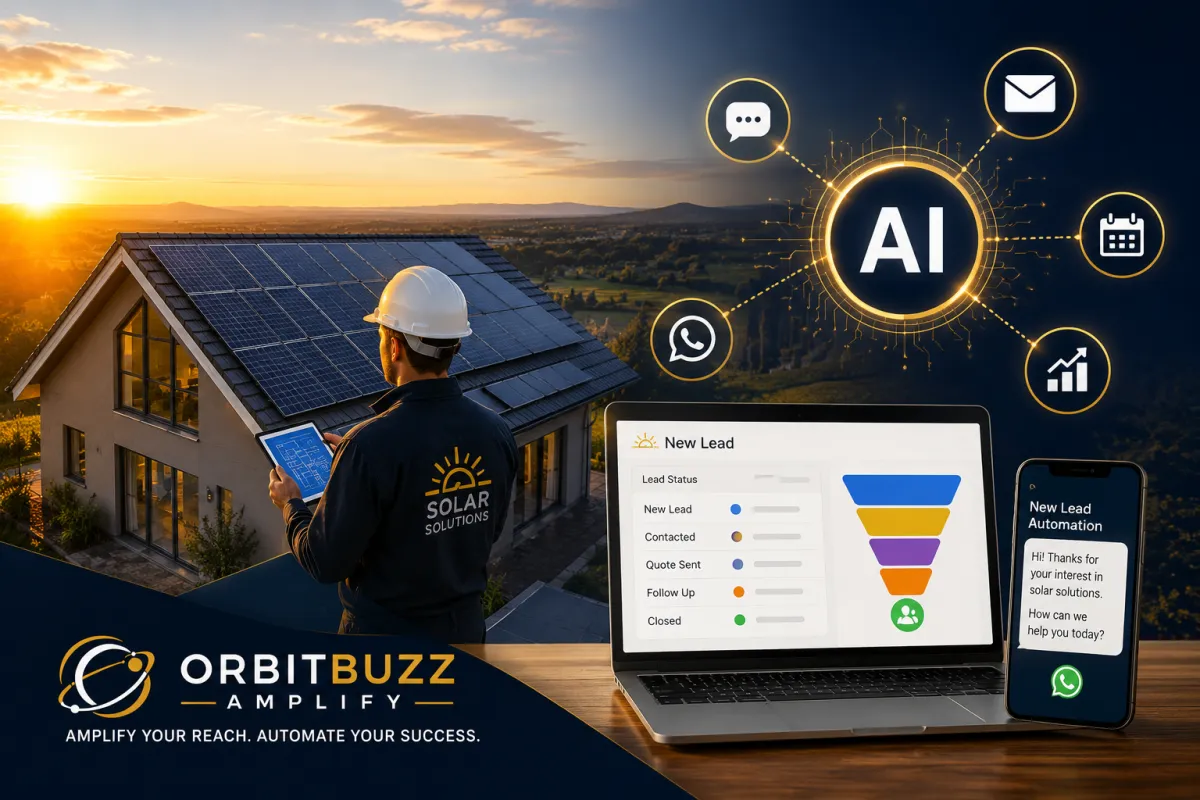
How AI & Marketing Automation Are Transforming Solar Businesses in South Africa
How AI & Marketing Automation Are Transforming Solar Businesses in South Africa
South Africa's solar industry is booming. The demand is undeniable. But for most solar SMBs, the real problem isn't getting enquiries — it's converting them into customers before a competitor does. That's where AI and marketing automation are quietly changing everything.
The Solar Opportunity Has Never Been Bigger
South Africa's solar sector is in the middle of a structural transformation driven by years of grid instability, rapidly rising electricity costs, and a private sector that has decided it can no longer wait for Eskom to solve its problems.
The numbers tell the story clearly. South Africa's solar energy market was valued at 8.75 gigawatts in 2025 and is projected to reach 16.88 gigawatts by 2031 — growing at over 11% per year. Industry alone has installed 4 GW of solar capacity, double what public independent power producers have managed. With Eskom tariffs having risen 182% over the last five years, the question for most businesses and homeowners is no longer "should I go solar?" but "who should I call?"
Here are three numbers every solar business owner should know:
📊 182% — Eskom tariff increase over the past five years
📊 11.58% — Annual growth rate of South Africa's solar market through to 2031
📊 Less than 10% — The share of South African households that currently have solar installed
That last statistic is the one to focus on. Less than 10% of South African households have solar. The market is enormous. The leads are out there. The real question is whether your business has the systems to capture and convert them.
The Problem: A Fast Market, Slow Sales Processes
Here is the uncomfortable truth for most solar SMBs in South Africa: the demand is there, but the sales process is not keeping up with it. Solar providers across the country are still struggling with manual quoting systems, slow follow-up, and sales methods that depend entirely on individual effort and memory.
Consider what happens when a potential customer sends an enquiry on WhatsApp on a Tuesday afternoon. The installer is on a rooftop in Middelburg. By the time the message gets seen and a reply goes out — maybe three hours later, maybe the next morning — that customer has already had a conversation with two other installers who responded within minutes.
"In South Africa's competitive solar market, the company that responds first wins. Businesses that respond to leads within 5 minutes are 21 times more likely to convert than those that wait 30 minutes."
— Harvard Business Review, cited in Digital4Jesus SA Market Report 2025
This isn't a discipline problem. It's a systems problem. Solar is also not a quick sale. Most residential and commercial solar customers need six to twelve meaningful touchpoints before they sign. That means follow-up calls, WhatsApp messages, email check-ins, quote reminders, and objection handling — over days and sometimes weeks. Doing all of that manually, for every lead, across a busy installation schedule, is simply not sustainable.
The result? Revenue walks out the door every single week — not because the product isn't right, not because the price is wrong, but because the follow-up never happened.
What AI Is Already Doing in South Africa's Solar Industry
AI-Powered On-Site Quoting
The most visible AI adoption in the South African solar space has been on the technical sales side. AI platforms now available to installers on-site have removed the friction of the traditional quoting process. Instant quotes can be generated on location, automated financing approvals obtained at the point of sale, and customers can commit while the installer is still standing in front of them — answering questions and walking them through the numbers in real time.
Historically, solar systems were specified based on broad generic assumptions, often resulting in systems that were either too large or too small for a customer's actual needs. AI-driven quoting tools use real consumption data to right-size the system from the start, which builds trust and removes the "let me think about it" objection that kills so many deals.
AI-Driven Energy Optimisation
South African solar company Wetility has pioneered what they call "AI Mode" — a system that connects to a customer's solar installation and gathers millions of real-time data points from solar production, weather forecasts, and household consumption patterns. It then automatically adjusts settings, deciding when to store or use power, and delivers up to 90% guaranteed savings.
This isn't just a technical feature — it's a powerful marketing and retention tool. Customers who see their system optimising itself, reducing their bills month after month, become advocates. They refer neighbours, share results, and don't churn. AI built into the product becomes the best sales tool the business has.
The Broader AI Landscape in South Africa
South Africa's overall AI market is growing at 22% per year and is projected to reach nearly USD 6 billion by 2033. Yet as of 2025, fewer than 15% of South African SMEs have implemented any form of AI automation. That gap represents a significant first-mover advantage for businesses that act now.
Early adopters are already reporting measurable wins in lead response time, customer experience, and operational efficiency. According to McKinsey research, businesses implementing AI automation report productivity gains of 20–40% and customer acquisition cost reductions of up to 50%.
One more local context factor worth noting: WhatsApp is used by 93.8% of South African internet users. Any marketing automation strategy for the South African market must centre WhatsApp. Solar customers expect to communicate there — and businesses that automate WhatsApp engagement have an immediate edge over those still relying on email alone.
The Four Revenue Leaks Every Solar Business Needs to Fix
Before looking at what marketing automation can do, it helps to name exactly where the money is going. Most solar SMBs lose revenue in the same four places:
1. Lead Capture Failure
Enquiries arrive through Facebook, WhatsApp, website forms, Google, and word of mouth — with no unified system to catch and track them all. Leads disappear before the first meaningful conversation takes place.
2. Slow or Inconsistent Follow-Up
Solar closes on the back of consistent touchpoints. When those touchpoints depend entirely on one person's memory and availability, they don't happen — especially during busy installation periods.
3. Dead Leads Left Unworked
Most solar businesses have dozens — sometimes hundreds — of old enquiries sitting in WhatsApp or a spreadsheet. Many of those leads went quiet, not because they lost interest, but because they got busy. The right re-engagement message, sent at the right time, can bring a significant portion of them back.
4. No Post-Installation Nurture
A satisfied solar customer is one of the best referral sources available. But without a system to request reviews, generate referrals, and offer add-on services at the right moment, that relationship ends the day the installation is signed off.
How the OrbitBuzz Amplify System Plugs Every One of These Gaps
OrbitBuzz Amplify operates on the VanX platform — an all-in-one marketing automation and CRM system already used by solar and home improvement businesses globally, now brought to SMBs across Mpumalanga and Limpopo with local knowledge, local pricing, and local support.
Here is what the system actually does for a solar business, in practical terms:
⚡ Instant Lead Response
The moment a prospect submits a form, sends a WhatsApp, or engages with a Facebook ad, an automated response fires within seconds — personalised, professional, and branded. No manual intervention required, even at 11pm or during a full day on site.
📋 Automated Quote Follow-Up
After a consultation or site visit, quote templates trigger automatically via WhatsApp, SMS, or email. No quote sits unacknowledged while the sales rep moves to the next job. Every proposal gets followed up on schedule.
🔄 Long-Term Lead Nurturing
Automated sequences nurture leads for 30, 60, even 90 days without the owner lifting a finger. Solar is a considered purchase. Most buyers need multiple touchpoints before they commit — the system handles those touchpoints consistently, every time.
💬 Dead Lead Revival
Old enquiries that went cold can be imported and immediately dropped into re-engagement sequences — WhatsApp messages that re-open conversations without sounding pushy or desperate, at scale.
📅 Automated Appointment Booking
Leads can book site visits directly through an automated calendar system, with confirmation and reminder messages sent automatically. No back-and-forth. No missed appointments. Fewer no-shows.
⭐ Reputation & Referral Automation
Once an installation is complete, the system automatically requests a Google or Facebook review and triggers a referral sequence. Satisfied customers become active promoters — without you having to ask manually every time.
"Three weeks into using VanX, I got a call from a lead my automated follow-up had been nurturing for 47 days without me touching it. She was ready to sign. That one deal covered my subscription for the next two years."
— Independent Solar Sales Rep, 400+ closed deals (Solar With Watts, 2026)
Why This Matters More in South Africa Than Almost Anywhere Else
WhatsApp is the battlefield. With 93.8% of internet users on the platform, the solar customer expects to communicate there. The OrbitBuzz Amplify system centres WhatsApp as the primary channel for lead capture, follow-up, nurturing, and re-engagement — exactly where South African customers are.
Load shedding creates urgency — but urgency fades fast. When the power goes out, solar interest spikes. Potential customers search, enquire, and WhatsApp installers in moments of genuine pain. That window is short. The businesses that capture and respond to those enquiries within minutes — automatically, even at 2am during Stage 6 — are the ones that convert them.
Competition is intensifying. As more solar companies enter the market and consumers become more informed, the differentiator is increasingly the experience of the buying process itself. Speed, professionalism, and consistent follow-up are becoming the competitive battleground. Automation is the infrastructure that makes consistency possible at scale.
SMBs cannot afford to lose leads. For a small solar installer in Middelburg or Groblersdal, every lost lead is material. A single residential installation can be worth R80,000 to R200,000 or more. Losing one lead a week to slow follow-up or poor systems is a significant annual revenue leak — one that marketing automation pays for many times over.
What AI Adoption Looks Like in Practice for a Solar SMB
The good news is that implementing AI and marketing automation in a solar business does not require a large team, a big technology budget, or any coding knowledge. OrbitBuzz Amplify builds and manages the system on your behalf or will provide training to your team to do it yourselves.
The typical setup process looks like this:
Step 1 — Audit: We assess your current lead sources, response processes, and conversion gaps to identify where the biggest revenue leaks are.
Step 2 — Build: We set up your CRM pipeline, WhatsApp automation, lead capture forms, follow-up sequences, and appointment booking system — configured specifically for a solar business.
Step 3 — Activate: Your first automated sequences go live. Every new lead is captured, acknowledged within seconds, and entered into a nurture sequence. Every old enquiry gets a revival message.
Step 4 — Optimise: As the system runs, we track open rates, reply rates, and conversion data to refine what's working and eliminate what isn't.
Most businesses see measurable improvements within the first two to four weeks. Lead response times drop from hours to seconds. After-hours lead capture increases significantly. Appointment booking rates improve. And for the first time, business owners have complete visibility into exactly where every lead is in the pipeline.
The Bottom Line for South African Solar Businesses
South Africa's solar market is growing at double digits year on year. The customer demand is real, the economic case for solar is compelling, and the pipeline of potential customers is larger than it has ever been.
The businesses that will dominate this market over the next five years are not necessarily the ones with the best panels or the lowest prices — they are the ones that respond fastest, follow up most consistently, and convert the most leads into customers.
AI and marketing automation are no longer future considerations. They are already being used by forward-thinking solar businesses globally and, increasingly, by early movers right here in South Africa. The gap between businesses that have these systems and those that don't is widening every month.
OrbitBuzz Amplify brings this technology to solar businesses in Mpumalanga and Limpopo — practically, affordably, and with ongoing local support. If your business is generating leads but losing them to slow responses, inconsistent follow-up, or disorganised pipelines, the system exists to fix exactly that.
The question isn't whether you can afford to automate. It's whether you can afford not to.
Ready to Find Out Where Your Solar Business Is Leaking Revenue?
Get a free personalised video audit of your current marketing setup — we'll show you exactly where leads are falling through the cracks and what to fix first. No cost. No obligation. Just honest, practical feedback.
👉 Request your Free Video Audit: https://orbitbuzzamplify.com/free-video-review-request-831550
👉 Try the Revenue Leak Calculator (60 seconds): https://orbitbuzzamplify.com/revenue-calculator-page