How Fast Are You?
The 60-Second Follow-Up Test: Are You Passing It?
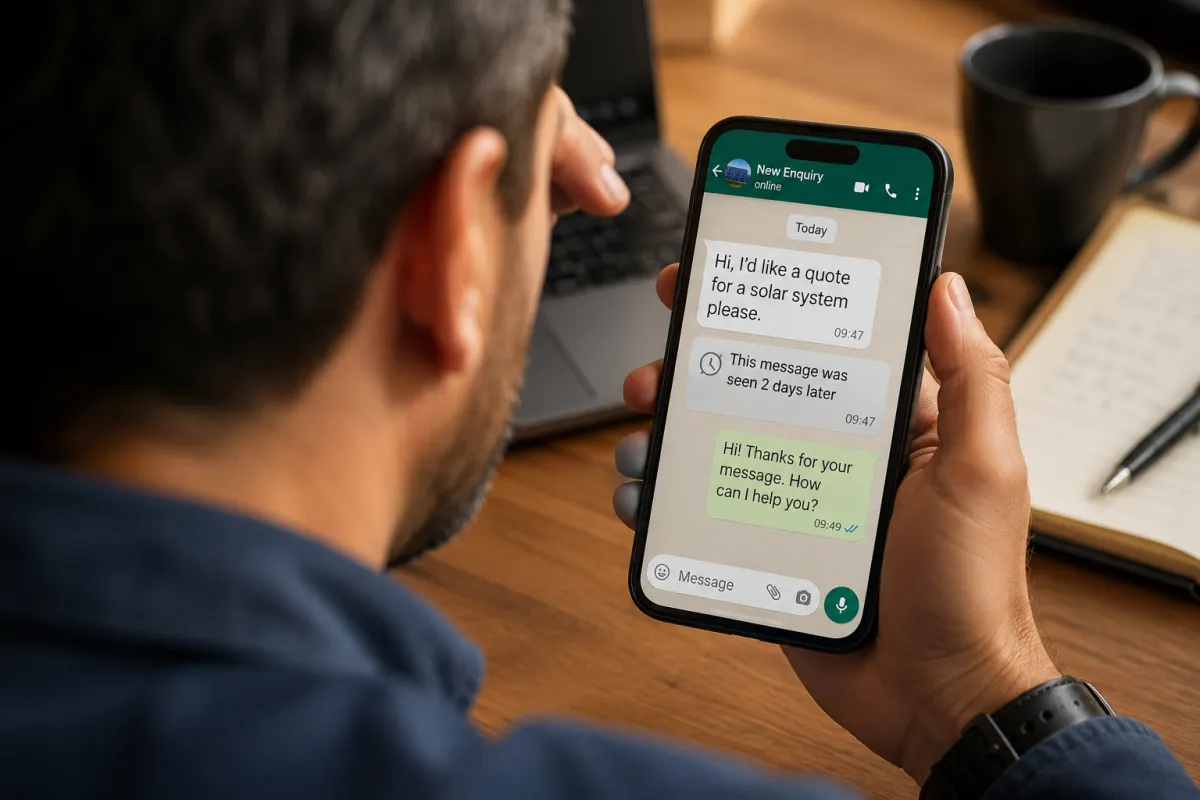
Someone messages your business on WhatsApp. Or fills in a contact form on Facebook. Or sends an enquiry through your website.
How long does it take you to reply?
If your answer is "whenever I check my phone" or "by the end of the day," you're losing money to competitors who respond faster. In 2026, 78% of customers buy from the first company that responds to their enquiry. Not the best company. Not the cheapest. The first one to reply.
This article will show you why 60 seconds has become the new local standard, what happens when you're slower than that, and how automation makes it possible without hiring extra staff.
Why 60 Seconds? The Psychology of Speed in a Cautious Market
Recent research indicates that 92% of customers in South Africa expect quicker service as technology advances. Your prospective clients have been trained by instant messaging, chatbots, and same-day delivery to expect immediate responses.
When you take hours — or even 30 minutes — to reply, they don't think you're busy. They think you're not serious.
Responding within 1 minute can see conversion rates increase by up to 391% compared with slower follow-ups. Responding to an enquiry in the first 5 minutes makes a prospect 21 times more likely to be qualified than if contacted after 30 minutes.
After five minutes, interest starts to fade. By the time you call back "later," they've already moved on to someone else.
What Most Limpopo and Mpumalanga Businesses Get Wrong
You might be thinking: "But I run a small business. I can't sit by the phone all day."
That's exactly the problem. Most local businesses treat follow-up as something a person must do manually. A task to remember. A sticky note on the desk.
Here's what that looks like in practice:
A quote request comes in at 10:42 a.m. while you're meeting with a client.
You see it at lunch and make a note to call later.
The afternoon gets busy. You finally reply at 4:30 p.m.
No answer. You leave a message.
They never call back.
Meanwhile, your competitor — who may not even offer a better product — replied in two minutes with an automated WhatsApp message that said, "Got your enquiry! When's a good time to chat?"
They got the booking. You got silence.
The Real Competitor Isn't Another Business — It's the Missing System
89% of customers expect a reply within one hour. But the cross-industry average is 12 hours and 10 minutes.
That gap is where money leaks out of your business.
The good news? Nearly two-thirds of companies fail to respond within 60 minutes. This widespread failure to execute means that businesses who do respond quickly have an enormous competitive advantage.
You don't need to be perfect. You just need to be faster than the other guy still using a notebook and his memory.
How Automation Makes 60 Seconds Possible (Without Hiring Staff)
Let's be clear: no human can reply in 60 seconds, every time, seven days a week. But a system can.
This is what marketing automation does. When someone submits a form, sends a WhatsApp message, or fills in a form on Facebook, the system fires an instant reply. It books them into your calendar. It sends a follow-up if they go quiet.
You're not glued to your phone. The system does the remembering.
Here's a real example from a Groblersdal service business:
Before automation, they were averaging four hours to respond to website enquiries. Lost about 60% of those enquiries to silence. After setting up an automated first reply and a two-day follow-up sequence, their response time dropped to under 90 seconds and conversion jumped by 34% in the first month.
Nothing changed except the system. Same owner. Same product. Same price. They just stopped losing people in the gap.
What a 60-Second System Looks Like in Practice
You don't need a big complicated setup. Start simple:
Step one: Instant acknowledgment. When someone enquires, they get an automated reply within seconds: "Thanks for reaching out! We'll send you the info you need in the next few minutes."
Step two: Human follow-up (or smart automation). If it's a pricing question, the system sends a pre-written answer with your rates and a calendar link. If it's something custom, it notifies you to reply personally — but the prospect already knows you're paying attention.
Step three: Recovery follow-up. If they don't respond, the system sends a friendly check-in two days later. No nagging. Just: "Still interested? Let me know if you have questions."
The goal isn't to replace you. It's to catch the enquiries that would have slipped through the cracks while you were doing the actual work of running your business.
Speed = Seriousness (Especially in a Cautious Market)
94% of customers in South Africa agree the experience a company provides is as important as its products and services. And experience starts the moment someone reaches out to you.
When you reply fast, you signal:
You're organized.
You're available.
You take their enquiry seriously.
When you're slow — even if you eventually follow up — you signal:
You're overwhelmed.
You're not paying attention.
Maybe you're not the safe choice.
In a cautious market, people buy from businesses that feel reliable. Speed is part of that reliability.
The Cost of Staying Slow
Let's do simple maths.
Say you get 20 enquiries a month. You're currently responding in about four hours (which is better than the 12-hour average, by the way). You close about 25% of those enquiries.
If you dropped your response time to under 60 seconds, text-based responses delivered within 60 seconds achieve a 73% appointment booking rate, while responses delivered after 30 minutes achieve just 4%. That is an 18x difference in booking rate based solely on response speed.
Even if you don't hit 73%, getting to 40% or 50% means three to five extra clients a month. For a Limpopo contractor charging R8,000 per job, that's R24,000 to R40,000 in recovered revenue — per month — just by fixing follow-up speed.
You Don't Need to Be Tech-Savvy. You Need a System That Works.
Most small business owners think automation is complicated. It's not.
You need three things:
A tool that captures enquiries (WhatsApp, Facebook, your website form).
A CRM that stores the contact and triggers the follow-up.
Pre-written message templates so the system knows what to say.
Once it's set up, it runs in the background. You get notified when a real conversation starts. The system handles the rest.
Think of it like this: you wouldn't run your business without accepting card payments because "cash is simpler." Automation is the same. It's just modern infrastructure.
Your Next Step
If you're not sure how much revenue you're losing to slow follow-up, start by measuring it. Our Revenue Leak Calculator shows you exactly how much money is slipping through the cracks when enquiries go cold.
Run the numbers here: https://orbitbuzzamplify.com/revenue-calculator-page
If the number surprises you (it usually does), the next step is simple: set up a system that follows up automatically so you stop leaving money on the table.
You don't need a bigger team. You need a system that doesn't forget.
Internal links used:
After publishing, submit this post's URL to Google Search Console (Request Indexing).